The Economics of a $4.50 Breakfast Sandwich
It’s 8:17am on a brisk Tuesday morning and the line at Sunny and Annie’s in the East Village moves with unexpected rhythm. Everyone knows what they’re going to order before they even glance at the menu board, and the cashier greets every other customer by name. The guy in front of me orders his “usual” while the line cook is already reaching for the eggs.
I order a bacon, egg, and cheese on a hard roll. Salt, pepper, ketchup, as always. The cashier wraps it in tin foil with the efficiency of someone who’s done this ten thousand times. Maybe three minutes after I placed my order, I’m tapping my phone and exiting the store with only five less dollars than I entered with.
A bodega isn’t just a convenience store. It’s the pulse of the block, a microcosm of the city itself, and home to some of the best cheap eats in the city. But watching the morning rush, I started wondering about something: how does a place like this actually make money?
The Numbers
Sunny and Annie’s storefront is maybe 600 square feet on Avenue B between 6th and 7th street. Comparable retail space in the East Village runs $200-$300 per square foot annually. That’s $10,000-15,000 per month in rent alone, before you factor in utilities, insurance, labor, inventory, or the fact the owners probably work 14-hour days, six days a week.
My $4.50 breakfast sandwich probably breaks down something like this:
Roll: $0.40
Two eggs: $0.35
Bacon: $0.60
Foil, condiments, napkin: $0.15
Total cost: $1.50
Gross profit: $3.00
To clear $15,000 in rent, they need to sell 5,000 sandwiches a month. That’s 167 per day, every day. Again, that’s just rent.
Add in two employees ($15/hour x 14 hours x 30 days = $12,600). Plus electricity, insurance, supplier costs, credit card fees. They probably need to do $50,000-60,000 in monthly revenue just to keep the lights on.
For the size of a studio apartment in East Village.
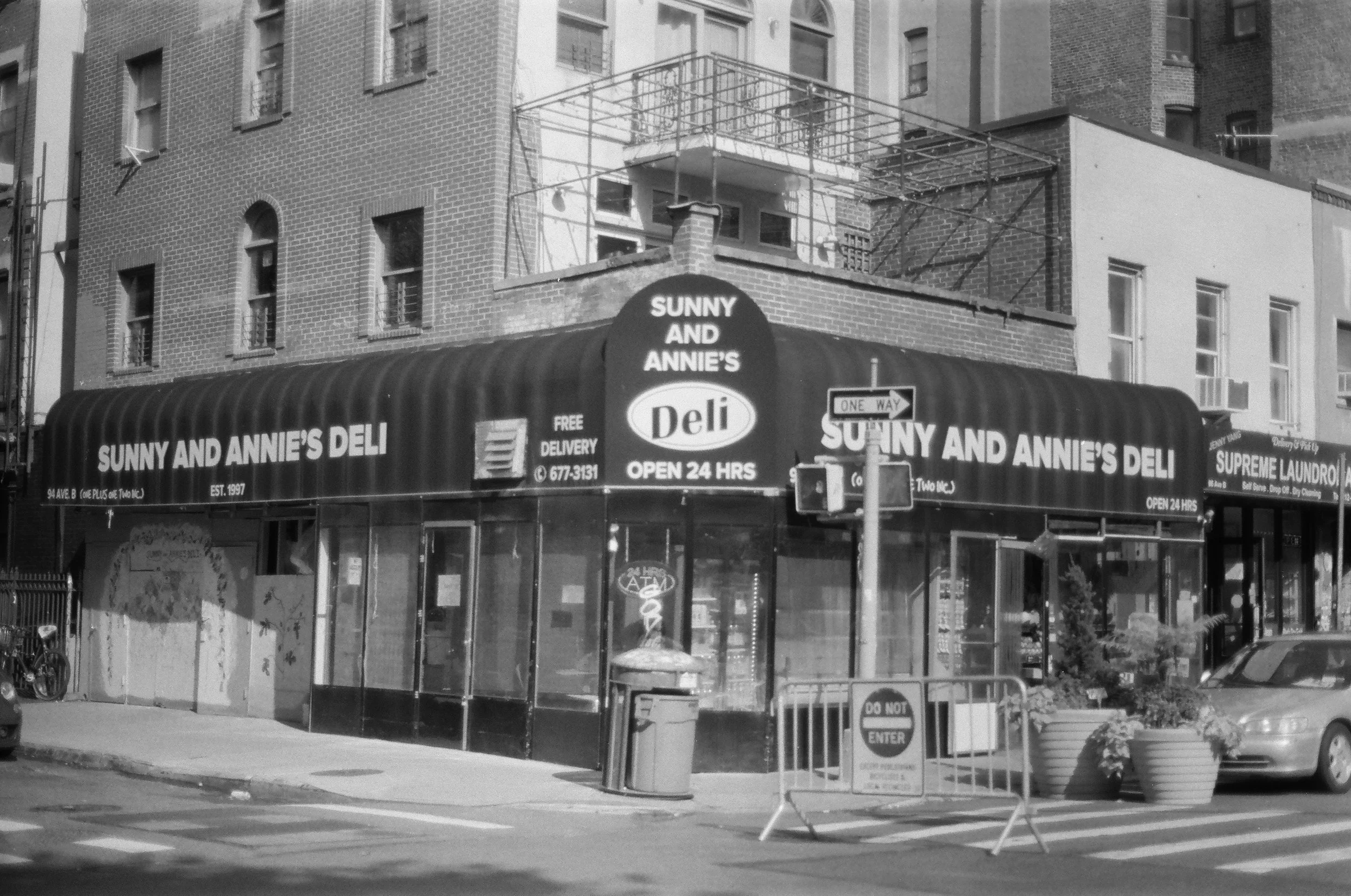
Sunny and Annie’s Deli, 94 Avenue B, New York, NY 10009
What the Math Misses
Here’s what those numbers don’t capture: Sunny and Annie’s is never just selling you a sandwich.
I watch the 8:30am rush. The construction worker who buys a sandwich also grabs a Gatorade ($3), a bag of chips ($2), and a pack of Newports ($15). The fitness instructor picking up her egg white wrap adds a green juice ($7) and a banana ($1). The delivery guy getting his tuna wrap throws in a Red Bull ($3.50) and pays for a phone charger ($15).
The sandwich is the hook. The margin is everything else.
The Harder-to-Replicate Part
What really makes these places work isn't just in the P&L, it's the informal systems that would be hard for big chains to replicate.
The cashier at Sunny & Annie’s knows that the older woman who comes in every morning will need her coffee ready at exactly 7:45am, two sugars, light cream, no lid because she drinks it at the bench outside. She knows the students who live upstairs have an allowance from their parents and will pay $8 for a pressed juice without blinking. She knows the contractor crew that shows up at 6am every Monday needs their orders batched (six BECs, three coffees, two Arizona Iced Teas) and she has it ready before they finish walking in.
This is inventory management and customer segmentation that happens entirely in her head. No CRM, no data analytics, no algorithmic pricing. Just thousands of hours of pattern recognition.
These behaviors don't show up in a business model, but they're the difference between your local bodega and a 7-Eleven.
Why I Keep Thinking About This
There are roughly 12,000 bodegas across the five boroughs. Most are independently owned. Most run on razor margins. And yet they survive in one of the most expensive retail environments in the world.
I think they survive because they've figured out something that modern tech companies spend millions trying to solve: how to own a micro-market so completely that you become part of the infrastructure.
Sunny and Annie's isn't really competing with Dig Inn or Sweetgreen or the Whole Foods three blocks away. They're competing with the friction of walking an extra two minutes. When you're running late and need coffee, when you forgot milk, when you want your breakfast sandwich, that's when the bodega comes out on top.
As I unwrap my sandwich on the bench outside (no plate, no seating, no ambiance), I'm amazed at the foot traffic that continues to go into the store. This place has turned 600 square feet into a business that works because it understands that in the city, convenience is everything.